


Moissanite Colour Grade Guide for Bright Rings
A moissanite ring can look bright, crisp and seriously luxurious without the traditional diamond price tag. But when you see letters such as D, E, F or G-H on a product page, what are you actually getting? This moissanite colour grade guide makes the choice simple, so you can spend on the design, size and sentiment that matter most to you.
What moissanite colour grades mean
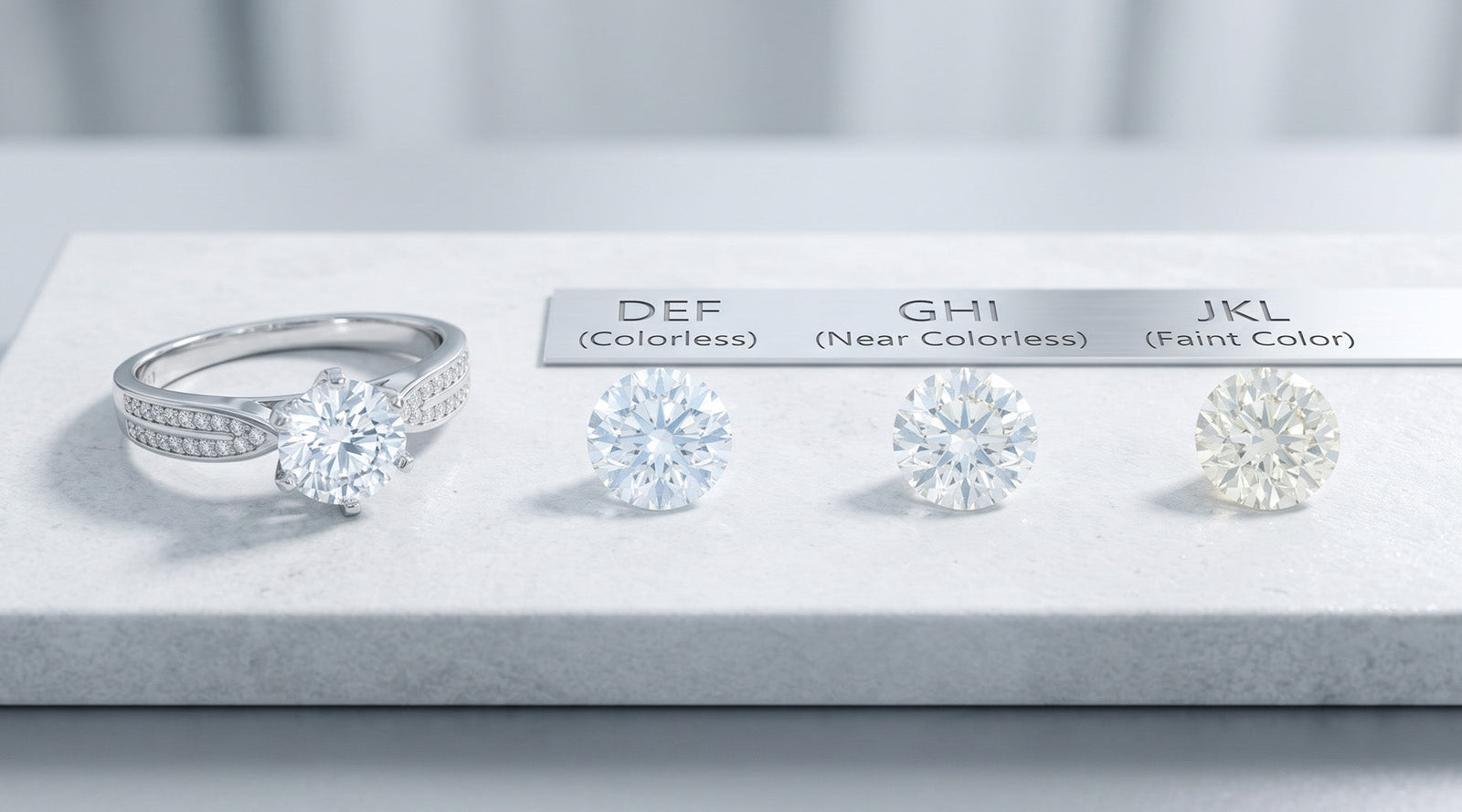
Colour grading describes how much visible body colour a clear moissanite stone has. At the top of the scale, D, E and F stones appear colourless. As you move down through G, H, I and beyond, a little warmth becomes more noticeable - usually a soft yellow, cream or greyish tint in certain lighting.
The key point is that moissanite colour grading is not governed by one universal standard in quite the same way as diamond grading. A supplier may use the same D-to-K language, but the exact appearance can vary slightly between stones, cutting styles and lighting conditions. Treat the grade as a useful buying guide, not a promise that every stone with the same letter will look identical.
Moissanite also has exceptional brilliance and fire. Those lively flashes of white light and rainbow colour can make a near-colourless stone look brighter face-up than you might expect. That is great news for shoppers who want maximum impact for their budget.
The colourless range: D, E and F
D-F moissanite is the icy-white, colourless end of the scale. It is the natural choice if you love a clean, bright look, are choosing a white gold or platinum-coloured setting, or simply want the closest visual match to a high-colour diamond.
For a solitaire engagement ring, especially with a larger centre stone, D-F offers that crisp, fresh-from-the-jeweller look from every angle. It is also a strong choice when pairing a moissanite engagement ring with a bright white eternity or wedding band.
There is a trade-off. Colourless grades typically cost more, and the difference between a D stone and an E or F stone may be extremely hard to spot once the ring is on your hand. If a slightly lower grade lets you choose a larger stone, a more substantial band or engraving with personal meaning, that can be a better-value decision.
Near-colourless: G and H
G-H moissanite sits in the near-colourless sweet spot. To most people, especially when viewed in normal daylight or across a dinner table, it still looks beautifully white. Any warmth is generally subtle and is easier to notice when the stone is placed beside a D-F stone or viewed from the side.
This range works brilliantly for shoppers who want a premium-looking ring while keeping the price sensible. The sparkle remains dramatic, and a well-chosen cut can make the stone look incredibly bright. For many engagement rings, anniversary gifts and everyday statement pieces, G-H is the practical choice that does not feel like a compromise.
Warm grades: I, J, K and below
I-J stones can show a faint warmth, while K and lower grades tend to have a more obvious tint. That does not automatically make them the wrong choice. A warmer moissanite can look intentional, romantic and characterful, particularly in yellow gold or rose gold.
These grades are often less expensive, which can make a larger centre stone or an elaborate halo design more achievable. They may also suit shoppers who prefer a vintage-inspired ring rather than an ultra-white, contemporary finish. Just make sure you are choosing warmth because you like the look, not because you expect it to be invisible.
If you are considering a large round stone in a white gold setting, colourless or near-colourless is usually the safer route. In a yellow gold solitaire, a subtle warm tone can blend in beautifully and give the ring a softer finish.
How to use this moissanite colour grade guide
The grade matters, but it is only one part of how a ring will look in real life. Think about the setting metal, the size and shape of the stone, and whether you want an icy-white or warmer style before focusing on one letter.
Match the grade to your metal
White gold, sterling silver and platinum-coloured settings tend to make warmth easier to see, particularly on a large centre stone. D-F or G-H stones usually create the cleanest match here.
Yellow gold is more forgiving. Its warm tone reflects through the stone and setting, so a G-H or even I-J moissanite can look harmonious rather than noticeably tinted. Rose gold has a similar effect and is ideal for a softer, more romantic aesthetic.
Two-tone rings give you options. A white-metal setting around the stone can keep it looking crisp, while a yellow or rose gold band adds warmth and personality. For this style, staying in the D-H range is often a confident choice.
Consider stone size and shape
The bigger the stone, the more readily you may notice body colour. A 0.5-carat equivalent stone can look very white in a near-colourless grade, while a three-carat equivalent may reveal more warmth under close inspection. If your heart is set on a bold centrepiece, consider D-F or G-H for the brightest appearance.
Round brilliant cuts are excellent at disguising colour because their many facets return plenty of light. Oval, pear and marquise cuts can show warmth more clearly towards their pointed ends. Emerald, Asscher and radiant cuts have broader facets, so colour may be easier to see than in a round stone. These shapes can still look stunning in a near-colourless grade, but colourless is worth considering if a crisp white look is your priority.
Think about the side stones too
A centre moissanite should sit comfortably alongside any accent stones. If a warm centre stone is surrounded by very white side stones, the contrast may make its tint more apparent. Matching the overall look is more important than chasing the highest grade on paper.
For pavé, halo and three-stone rings, ask whether the stones are selected to look consistent together. A well-balanced ring will appear more polished than one with a technically higher centre grade that clashes with its setting.
Colour is not the same as sparkle
Shoppers sometimes worry that choosing G-H rather than D-F means giving up brilliance. It does not. Colour measures body tint; sparkle comes mainly from the stone's cut, faceting and how light moves through it.
Moissanite is known for strong fire, which produces noticeable flashes of colour in sunlight and bright indoor lighting. Some people love that extra drama. Others prefer a quieter, diamond-like look. Neither preference is better, but it is worth knowing what catches your eye before you buy.
A stone can be colourless but poorly presented in dark, heavily filtered product imagery. Equally, a near-colourless stone can look fantastic when it has a precise cut and is set to let light reach it. Look for clear photos and videos in more than one lighting condition where available, and judge the whole ring rather than one isolated specification.
Is D-F always worth paying for?
Not always. D-F is worth it when you want the whitest possible moissanite, are choosing a larger stone in white metal, or know that colour differences will bother you. It can also be the right move for a forever ring you plan to wear alongside bright white diamond jewellery.
G-H is often the smartest all-round buy. It gives a bright, premium appearance, works across most popular ring designs and leaves more room in the budget for the details people actually notice: a flattering setting, a comfortable band, a meaningful engraving or a larger stone.
I-J and warmer grades make sense when you love yellow or rose gold, want a vintage feel, or are maximising size on a set budget. The best grade is the one that looks right to you in the ring you will genuinely wear, not the most expensive letter on a chart.
Moissanite is made to keep its beauty. Its colour will not fade with everyday wear, so choosing the right grade is about your style from day one, not a maintenance concern. Pick the shade that suits your setting, your budget and the moment you are celebrating - then enjoy a ring that looks every bit as special as the reason you chose it.
Also in Articles


Durable Rings for Work That Still Look Good
Find durable rings for work that suit your hands, job and style. Compare materials, safety needs, fit and finishes made for everyday wear without the fuss.

How to Engrave a Ring Without Getting It Wrong
Learn how to engrave a ring with the right words, font and placement, plus when a jeweller is the best choice for a clean, lasting finish.

Wide Versus Narrow Bands: Which Ring Suits You?
Choosing wide versus narrow bands? Compare comfort, proportions, durability and style to find a wedding or everyday ring you'll love wearing every day.
PayPal Pay Later Messaging
Step 1: Choose message placement
Click the button below and then hover over your page to select a placement.